Utility Resources
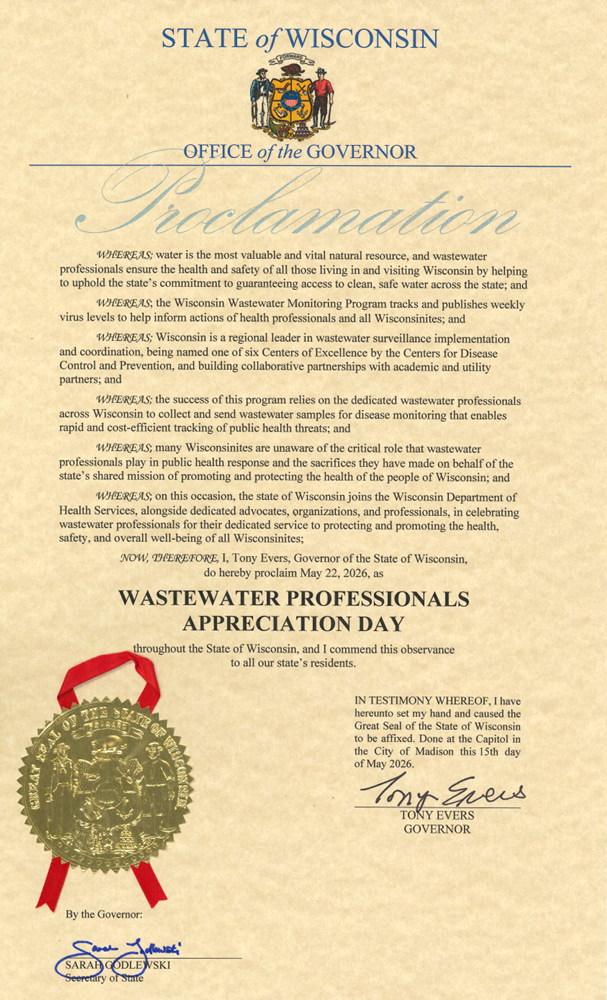
In recognition of the contribution of wastewater professionals to the protection of public health in Wisconsin, Governor Evers proclaimed May 22 as Wastewater Professionals Appreciation Day. In their petition to the governor’s office, the Wisconsin Department of Health Services highlighted the dedication and importance of wastewater professionals across Wisconsin:
“Since 2020, dedicated staff at wastewater treatment facilities across Wisconsin have provided more than 27,000 wastewater samples to the program. These contributions have allowed wastewater monitoring to become the most important and reliable source of data for COVID-19 in Wisconsin and the U.S. Each week, thousands of Wisconsinites check the public dashboards provided by the Wisconsin Wastewater Monitoring Program to view current levels of COVID-19, flu, and RSV, and are empowered to make informed decisions about their personal health, while hospitals and local public health departments are better prepared to respond to outbreaks. More recently, wastewater surveillance in Wisconsin has expanded to become a critical tool to monitor other public health threats like measles, bird flu, monkeypox, and for detecting outbreaks at large-scale events. None of this progress would have been possible without the dedication of wastewater utility workers, who believed in and participated in the wastewater monitoring program from the beginning. The program that began as just an idea in early 2020 has now grown into a pillar of Wisconsin’s public health infrastructure.”
Wisconsin Wastewater Monitoring Program
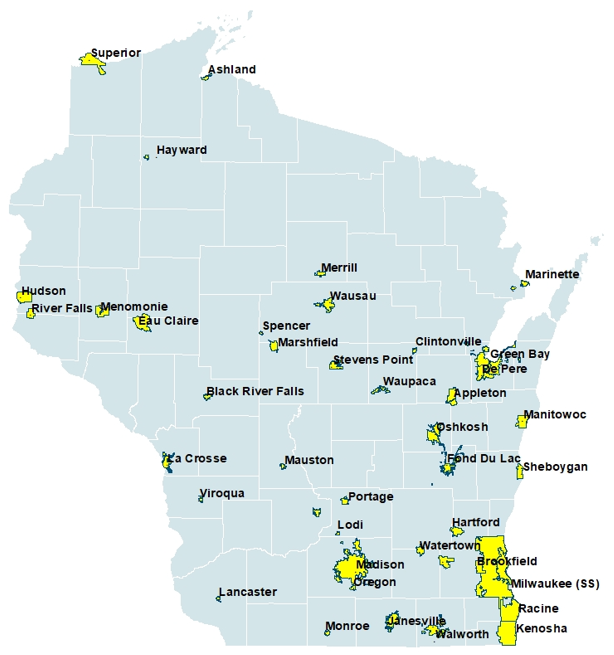
44 active treatment facilities
49.2% of total WI population
1,800 to 630,000 people served per site
*All sites conducting at least weekly sampling
Frequently Asked Questions
- Nearly 80% of United States households are served by municipal sewage collection systems.
- Testing influent (untreated sewage) from a wastewater treatment facility is an efficient way to obtain pooled community samples, representing the entire population serviced by that facility.
Many pathogens can be shed in urine or feces of individuals with symptomatic or asymptomatic infection.
- Pathogen levels measured in wastewater are independent of healthcare-seeking behaviors and a community’s access to clinical testing.
- Depending on the disease and testing frequency, sewage surveillance can be a leading indicator of changes in disease burden in a community.
- Results from wastewater testing are meant to complement, not replace, traditional clinical surveillance systems.
- Our key objective is to assist our public health partners in responding to any new or ongoing public health concerns.
- The overall goals of WWMP are to:
- Provide accurate and timely infectious disease data to Wisconsin public health departments
- Fill in potential gaps that can occur within traditional population testing
- Contribute to CDC’s National Wastewater Surveillance System that allows for robust regional and national trend monitoring.
- In Wisconsin, we are currently monitoring:
- Respiratory viruses such as SARS-CoV-2, Influenza A,B (seasonal flu), Bird Flu (H5N1) and RSV (respiratory syncytial virus)
- Norovirus, Measles and MPXV (mpox virus)
- Aditionally, we have developed methods to track hepatitis A, salmonella, Shiga toxin-producing E. coli, antibiotic resistant bacteria and yeast. We may conduct testing for these in the future based upon the Wisconsin DHS or CDC guidance.
- WWMP is funded through July 2027. Though, there are plans to continue through at least July 2029.
- However, the size of the network may change depending on funding levels, as well as state and national priorities. This means that future monitoring at some sites may be discontinued.
- The value of wastewater monitoring for infectious diseases has gained broader recognition globally, and in some cases, programs are supported by national or state funding.
- Research suggests that having a national wastewater surveillance system in place during a new pandemic could generate net benefits of nearly $1,500 per person in the first year.
- Results are provided weekly to designate personnel in emailed PDF reports. The reports contain graphical illustrations and interpretation of the site’s respiratory disease status.
- Results are also found on Wisconsin and national wastewater surveillance dashboards:
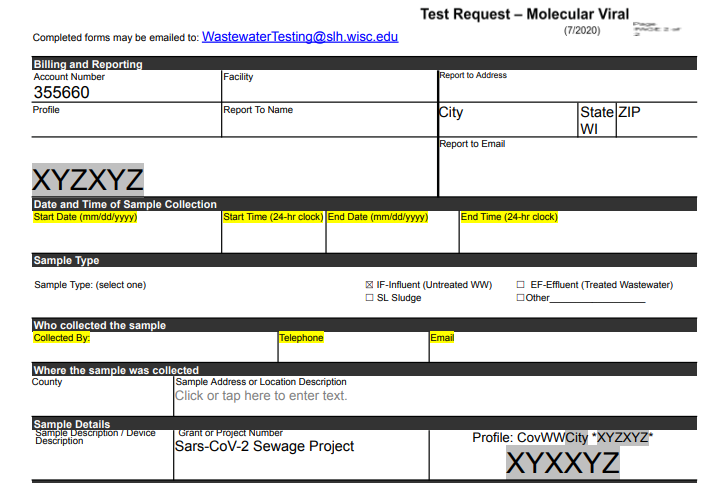
- All supplies are provided (sample bottles, shipping containers, shipping labels, all instructions, sample submission forms).
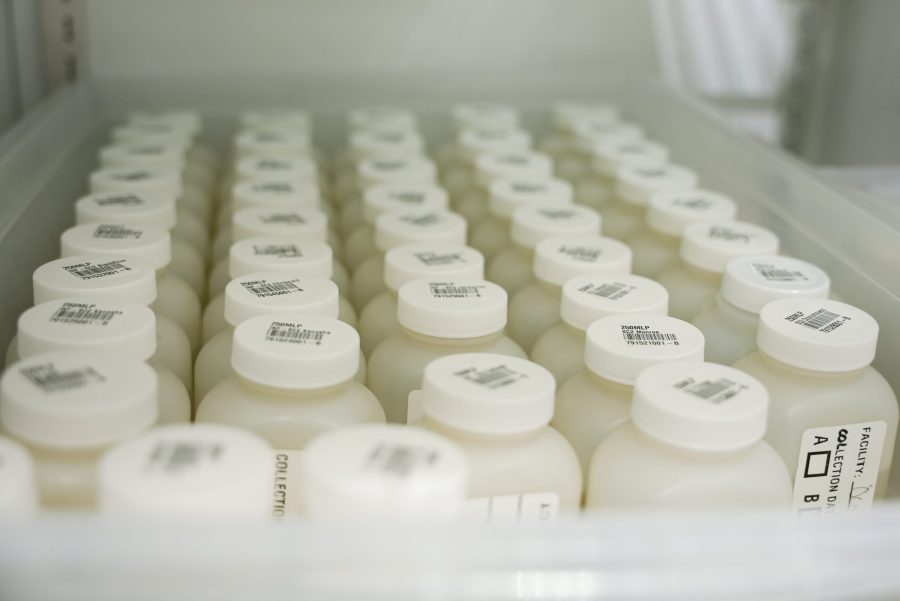
- A well-mixed, unpreserved 24-hour flow-weighted influent composite is preferred (typically one 250 mL bottle).
- Refrigerate sample immediately after collection and keep cool until shipping (4 – 8°C; 39 – 46°F). Do no freeze. Shipping same day as collected is preferred.
Refrigerated, untreated and unpreserved influent samples are ideal. Preservatives such as acids or other chemicals may degrade the sample’s genetic material required for the laboratory analysis.
- For the most reliable respiratory disease trends, it is important to submit samples on a weekly basis.
- If unable to ship a sample as scheduled: Keep the sample refrigerated until the next available shipping date and ship it as usual. Multiple samples may be combined into a single shipment.
- If unable to collect a sample as scheduled (e.g. sampler malfunctioned, staffing or maintenance issue): Please contact us at WastewaterTesting@slh.wisc.edu or (608) 263-2444, and collect the sample as soon as possible.
- Note: Do not ship on Fridays or immediately before holidays, as the lab will be unavailable to receive packages.
WWMP typically does not accept grab samples because the respiratory dashboards require a total daily flow value to display data accurately.
- If a technical issue prevents collection of a composite sample for a single day, please notify the wastewater team and do not ship a grab sample.
- If composite samples cannot be collected for an extended period (more than 1 week), please contact one of the following to determine whether a grab sample may be acceptable:
- WSLH Wastewater Testing: WastewaterTesting@slh.wisc.edu, (608) 2632444
- Wisconsin Department of Health Services: DHSWasteWater@dhs.wisconsin.gov
There is no charge for participating Wisconsin wastewater treatment facilities who use the provided pre-paid shipping label. Additionally, participating facilities are eligible for a yearly stipend to help offset costs of collecting, packing and sending in samples for analysis. Please contact WastewaterTesting@slh.wisc.edu for more information.
The Wisconsin Wastewater Monitoring Program is at capacity, but we may want to enroll a new site based on geographical or population representation criteria. Please inquire with the WSLH’s Wastewater Team WastewaterTesting@slh.wisc.edu or 608-263-2444.
Current scientific data strongly suggests that SARS-CoV-2 virus, and many other pathogens present in influent, are no longer infectious and therefore the health risk to wastewater operators is low. However, untreated wastewater poses other known health risks as some pathogens can remain infectious in the wastewater stream for a prolonged period of time. Therefore, use of personal protection equipment (PPE) like gloves and safety goggles is highly recommended.
For more information please visit:
For general inquiries regarding sampling or laboratory methods, please contact the WSLH Laboratory Wastewater Team
- Email: WastewaterTesting@slh.wisc.edu
- Telephone: (608) 263-2444
- Complete our Services and Inquiries Form
For public health response and epidemiology inquiries, contact the Wisconsin Department of Health Services dhswastewater@dhs.wisconsin.gov.
WWMP Utility and Local Health Call
The WWMP Utility and Local Health Call occurs quarterly on the 3rd Thursday of the month @10am. Please contact DHSwastewater@dhs.wisconsin.gov for more information.