Wastewater Proficiency Testing
The next round of wastewater PT is coming this fall! Estimated shipping is October 6th. This round will assess measles virus quantification only. Nucleic acids will be shipped, not raw wastewater. Enroll by September 18th.
Laboratory Proficiency Testing (PT) programs are a well-established means in clinical and environmental testing for measuring performance. The number of laboratories testing and reporting pathogen concentrations in wastewater has grown rapidly. As a result, various protocols are being used across laboratories. In contrast to traditional PT, where a laboratory is asked to analyze PT samples using prescribed protocols, our program asks participants to use their standard laboratory workflow. In addition, our PT program works hand-in-hand with participants to help advance their monitoring programs and aims to:
- Improve the quality and comparability of data submitted to the national network
- Identify higher performing methods
- Establish cross-network performance metrics and goals
Watch PT Data Submission Tutorial
Next PT Round:
PT Design, Data and Metrics:
Wisconsin State Laboratory of Hygiene launched the wastewater monitoring proficiency testing program in May 2024 focusing on respiratory pathogens: SARS-CoV-2, Influenza A, Influenza B, and RSV. We aim to offer two PT exercises per year, however, both the PT frequency and design can change in response to NWSS network needs.
Examples of testing results generated by the PT program:
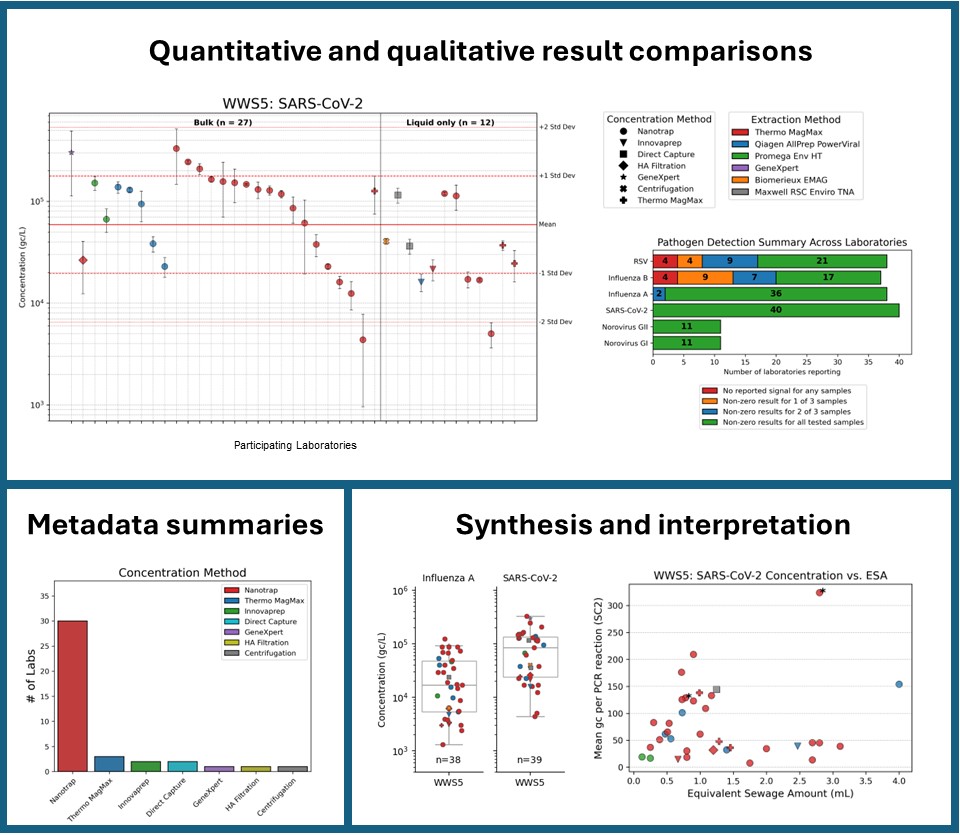
Please see the Services and Inquiries form if you have additional questions.
FAQs about Proficiency Testing (PT)
Our PT is not graded, accredited, or pass/fail. It is designed for labs to run samples using their routine workflow and compare results and recoveries across laboratories. The focus is on method evaluation, optimization, and understanding variability—not certification.
The PT exercises are intended for laboratories that actively conduct wastewater monitoring or are in the process of validating wastewater monitoring methods.
Yes. Because our PT is non-graded, it is well suited for validation work. You may run multiple assays or conditions as long as the relevant metadata is submitted to WSLH.
Use the workflow you routinely use (or plan to use) for wastewater surveillance. Depending on your workflow, we typically supply enough volume for replicates.
There is no cost to participate, however, we require that participants submit results and all meta-data to WSLH in a timely manner.
If your laboratory previously participated in a wastewater PT, you are already on our contact list and will be notified when enrollment opens for upcoming rounds.
If you have not participated before, please contact us at WastewaterPT@slh.wisc.edu.
Samples should be analyzed as soon as possible, and no later than 1 week from receipt.
Submit results to WSLH, including all appropriate meta-data, within 1 month of sample receipt. If that is challenging, please email us (WastewaterPT@slh.wisc.edu) to discuss a possible extension.
Assuming timely data submission and minimal data QC issues, a report should be generated within 6 weeks of data submission deadline. The report will be shared with all participants via email.
Being in the middle of the distribution, or even within same order of magnitude as other labs using similar methods, is generally considered good performance. These methods are inherently variable, and a wide range of results is normal.
If your results fall within the lowest quartile, consider reviewing your workflow for potential opportunities to improve recovery.
Note that raw dPCR positive partitions can be a better indicator of sensitivity than final gc/L concentrations, which are affected by processing volumes and conversion factors. When enough laboratories use the same workflow, we may also be able to provide cross-lab comparisons of positive partitions to help contextualize your performance.
Yes. We can pair labs that use similar methods so they can share SOPs and troubleshoot together. If you observe differences in recovery among labs using comparable approaches, we can help facilitate those connections.
PT samples are distributed only during official rounds. However, we can share information about the suppliers of our spike-in materials to support independent validation.
Our goal is to prioritize high-consequence pathogens that are also tested by a sufficient number of labs. Core respiratory pathogens such as SARS-CoV-2, influenza A/B, and RSV are expected to appear regularly. Additional pathogens (e.g., measles) may be included as sufficient laboratory participation becomes available.
Our goal is 2 PT rounds per calendar year, but additional rounds may be administered under special circumstances.
Through PT participation laboratories can:
Benchmark their results against other laboratories.
Participants receive a summary report showing how their results compare with laboratories using similar workflows, as well as those using different methods. This allows labs to understand where their results fall within the broader range of observed measurements.
Identify calculation or reporting issues.
Review of submitted PT data often reveals reporting challenges, such as unit conversion errors, misapplied processing factors, or calculation discrepancies. Addressing these issues can substantially improve the accuracy and consistency of reported data.
Evaluate the performance of their methods.
PT results help laboratories assess how their current concentration, extraction, and quantification workflows perform relative to other approaches used across the network. The more labs participate, the more robust the comparison.
Gain insight into sources of variability.
By comparing results across laboratories and workflows, PT exercises highlight methodological factors that may influence pathogen recovery and contribute to measurement variability.
Beyond the quantitative results, participants benefit from program feedback, technical support, and opportunities to learn from the experiences of other laboratories engaged in wastewater surveillance.