Community Resources
Many pathogens, including SARS-CoV-2, are shed by humans through urine and fecal matter an therefore accumulate in wastewater.
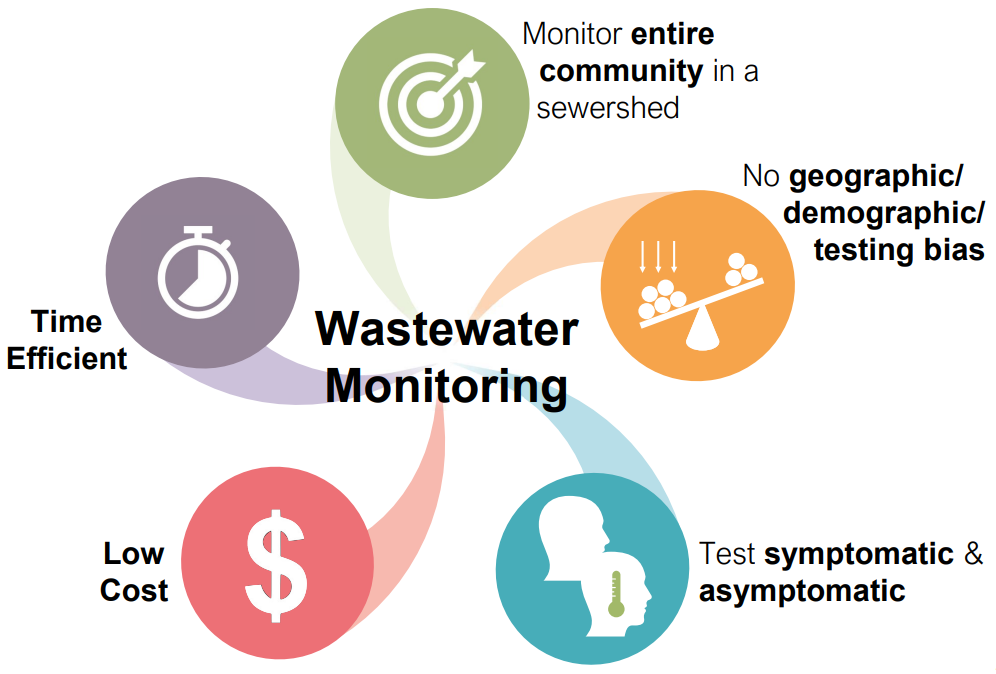
Assessing the level of an infection in a community by traditional approaches, such as identifying and tracking individual positive cases can be difficult and expensive. Many infected individuals have mild or no symptoms, making them unlikely to seek testing, while others may have limited access to healthcare services or testing.
In contrast, municipal sewer systems broadly collect wastewater providing a well-mixed sample of all households and businesses within a sewage district, resulting in a representative snapshot of a community.
Wastewater monitoring does not replace existing public health monitoring systems. Rather, it supplements them providing an independent–and sometimes more accurate–assessment of pathogen occurrence.

Wisconsin Wastewater Monitoring Program
Learn more about the program and why Wisconsin Department of Health Services is monitoring wastewater.
For a quick overview of respiratory viruses see the statewide Wastewater Respiratory Summary.
For a more in-depth view, check out COVID-19 and Influenza and Respiratory Syncytial Virus (RSV) levels in wastewater.
Glossary of Terms
This glossary of selected terms is curated by the Wisconsin Wastewater Monitoring Program staff and reflects terms used on wastewater surveillance websites. Definitions are deliberately tailored for lay audiences learning about wastewater-based disease surveillance.
For additional terms check out the California and New York resources.
Want to find out more?
- Check out Wisconsin wastewater dashboards to stay up to date on infectious diseases in your community.
- Listen to the Water Environment Federation Sewer Signals podcast featuring Sharon Mertens, the retired Director of Water Quality Protection at the Milwaukee Metropolitan Sewerage District.
- Tour your local wastewater treatment facility (WWTF). Most WWTFs are willing to organize tours for their community members. Tour information can be found online or available via phone call.
- Want to dig deeper? Listen to the National Science Foundation Research Coordination Network webinar series on wastewater-based epidemiology.
- Learn how wastewater is used to monitor the public health at large gathering events.
- See animated videos explaining how wastewater monitoring protects your community and privacy while tracking public health threats.