Laboratory Resources
General Resources
The Wisconsin State Laboratory of Hygiene is the main laboratory of the Wisconsin Wastewater Monitoring Program, receiving and analyzing samples from participating wastewater treatment utilities across the state. The Milwaukee Health Department Laboratory receives and analyzes samples from the two Milwaukee Metropolitan Sewerage District plants. The data from both laboratories is submitted to Wisconsin Department of Health Services and then to the CDC.
Overview of the sample processing workflow conducted by WSLH:
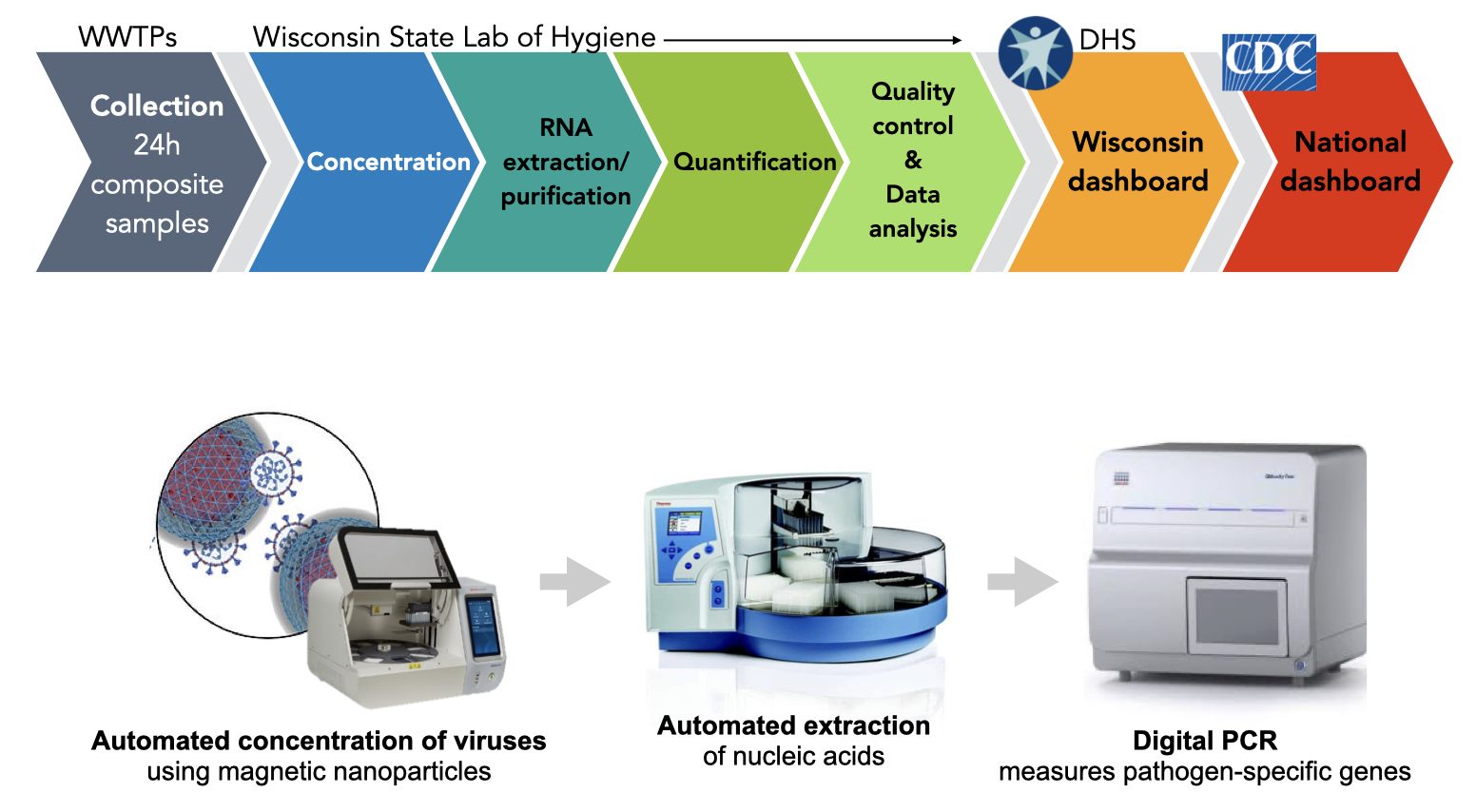
24-hr composite influent wastewater samples are shipped overnight on ice to the laboratory, where each sample is spiked with a recovery control (bovine coronavirus). Following the sample receipt, 10 mL of each sample is concentrated using Microbiome A Nanotrap® particles and consequently extracted using Promega’s Maxwell® HT Environmental TNA Custom Kit on the KingFisher platform. The extracted and purified nucleic acids are then analyzed for a suite of pathogen targets using Qiagen’s digital PCR (dPCR). The dPCR results are then analyzed, subjected to quality control checks and submitted to the Wisconsin DHS. The average time from sample receipt to the data report for SARS-CoV-2 is less than 36h.
Our laboratory also administers the Wastewater Surveillance Laboratory Proficiency Testing Program.
Wastewater Disease Monitoring – Laboratory Protocols & Guidelines
APHL’s Laboratory Testing Guide
The EU’s “International Cookbook for Wastewater Practitioners”
EU Wastewater Observatory for Public Health
Houston Center of Excellence “Best Practices for Wastewater Epidemiology”
APHL’s Wastewater Surveillance Resources Page
Sequencing
Wisconsin State Laboratory of Hygiene (WSLH) performs all routine sequencing for WWMP. WSLH conducts whole genome sequencing of SARS-CoV-2 from wastewater via a tiled-amplicon approach using total nucleic acid obtained for the routine wastewater surveillance. Details on the routine concentration and extraction workflows can be found above under “Concentration, Extraction, and PCR protocols”.
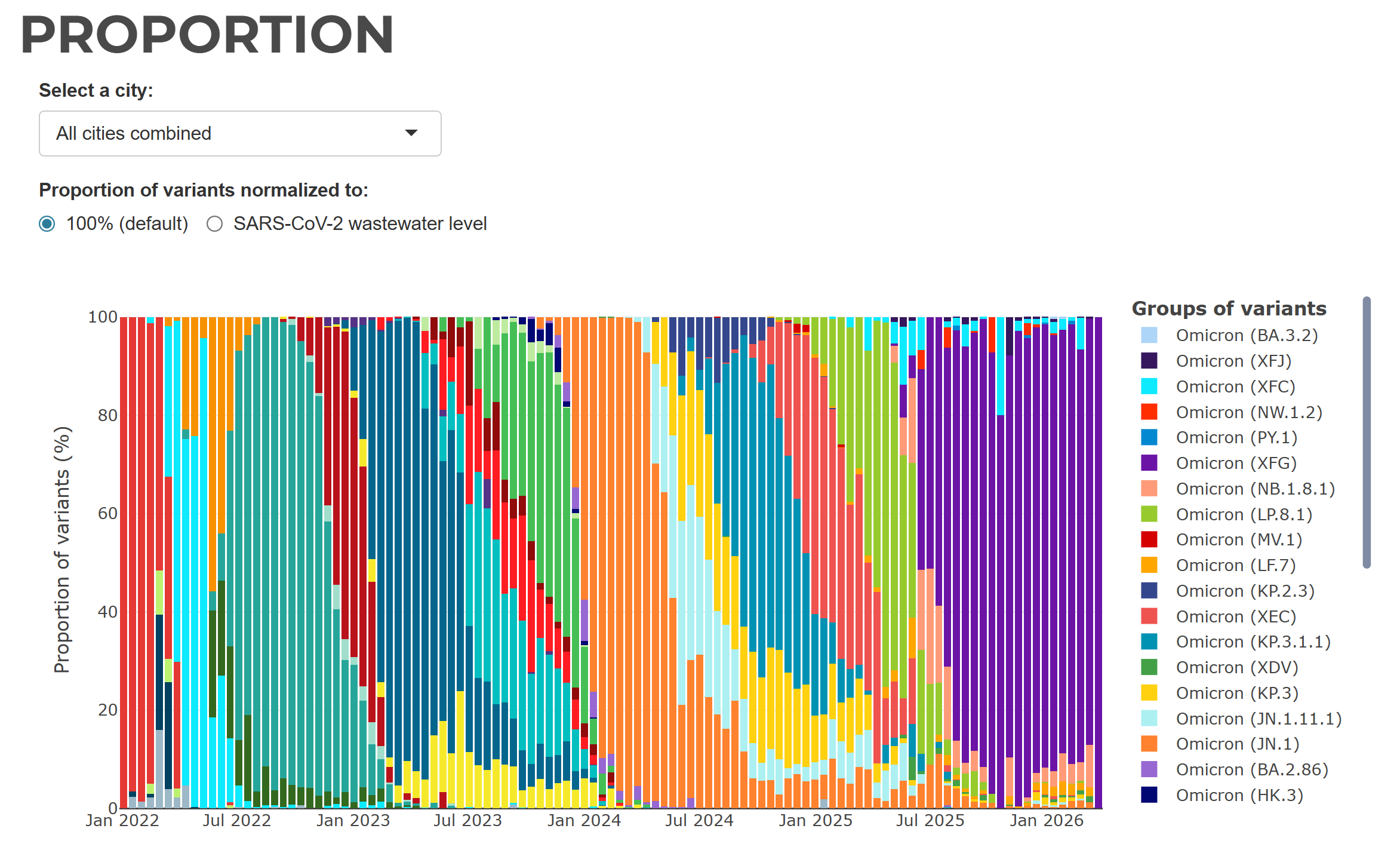
WSLH generates genomic DNA libraries using QIAseq DIRECT SARS-CoV-2 Enhanced kits with the primer Booster (Qiagen), following the manufacturer’s instructions. Briefly, an RT-PCR is done to transcribe single-stranded viral RNA into cDNA using hexaprimers. We then enrich SARS-CoV-2 genomes using a primer panel comprising approximately 550 primers to generate 425 amplicons (~375 nt) spanning the full viral genome. Unique dual indexes are added during a seven-cycle PCR. Before sequencing, we quantify the library by qPCR using the QIAseq Library Quant System kit (Qiagen) and assess the quality using the QIAxcel Advanced System (Qiagen). The DNA libraries are then sequenced on an Illumina MiSeq platform with MiSeq Reagent v2 kits (300 cycles).
We process FASTQ files using viralrecon, which now includes Freyja to estimate the variant proportion for each sample from the BAM files. We use the median from 10 bootstraps for these estimates. All our code, tailored for our Linux station, is available here.