Publications
Check out the contributions of our team members to the knowledge base of wastewater surveillance. The list includes peer-reviewed manuscripts as well as preprints and other publications.
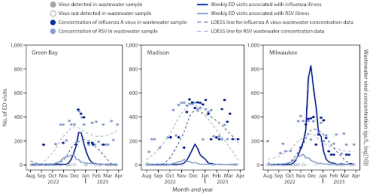
During August 2022–March 2023, influenza and RSV were tracked using wastewater surveillance and emergency department (ED) visits in three Wisconsin cities. A positive correlation between the two surveillance systems was observed. Wastewater surveillance detected increases in influenza and RSV that preceded increases in ED visits by weeks and persisted beyond declines in associated ED visits for up to 3 months.
DeJonge, PhD, P. M., & Adams, PhD, C. (2023). Wastewater Surveillance Data as a Complement to Emergency Department Visit Data for Tracking Incidence of Influenza A and Respiratory Syncytial Virus — Wisconsin, August 2022–March 2023. Morbidity and Mortality Weekly Report (MMWR).
The wide variety of wastewater-based surveillance (WBS) methods currently in use hinders the ability to compare data between different laboratories and limits the potential of nationwide surveillance programs. This study conducted a systematic analysis to identify among widely used concentration, extraction and quantification methods, the ones that perform better for WBS of SARS-CoV-2.
Antkiewicz, D., & Janssen, K. H. (2024). Wastewater-based protocols for SARS-CoV-2: insights into virus concentration, extraction, and quantitation methods from two years of public health surveillance. Environmental Science: Water Research & Technology, (8).
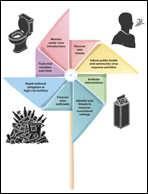
Environmental surveillance, including wastewater and air sampling, has emerged as a powerful complement to traditional clinical surveillance for monitoring viral circulation. This review summarizes recent developments in environmental surveillance systems and discusses how they can mitigate the introduction and spread of viruses in communities.
Machtinger,. (2025). Community-Scale Molecular Surveillance for Human Viruses. Annual Review of Virology.
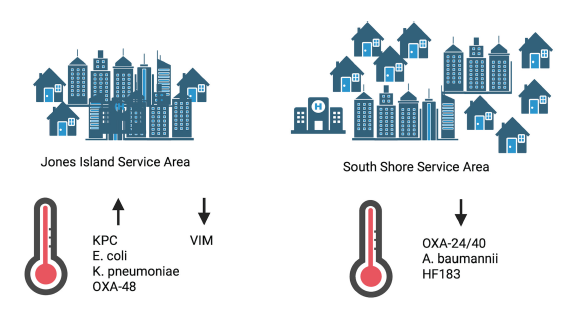
Wastewater surveillance has moved to the forefront as a practical and informative public health tool for assessing viral and bacterial pathogens in the human population; however, the usefulness for tracking antimicrobial-resistance genes (ARGs) of clinical concern is not straightforward given the large reservoir of free-living bacteria within sewer systems. This study examines carbapenem resistant genes and host organisms, which may serve as a valuable tool to assess the human burden of ARGs.
Schussman, M., (2026). Environmental reservoirs account for high levels of carbapenem resistance genes in wastewater. Microbiology Spectrum.
Pray et al., 2026, Genotype-Specific Detection of Measles Virus Using Wastewater Surveillance — Wisconsin, February 2026.
Mosavi SMR et al., 2025, ASM Journals, A 1-year study on SARS-CoV-2 variant shifts in wastewater using dPCR: comparison with clinical and GISAID data.
Dutcher H, Antkiewicz DS, Roguet AJ, Shafer MM. Implementation and Early Outcomes of Laboratory Proficiency Testing Program for National Wastewater Surveillance System, United States, 2024. Emerg Infect Dis. 2026;32(13)
Lenaker et al., 2024, STOTEN, A Multi-Marker Assessment of Sewage Contamination in Streams Using Human-Associated Indicator Bacteria, Human-Specific Viruses, and Pharmaceuticals.
McLellan et al., 2024, Nature Water, Universal Microbial Indicators Provide Surveillance of Sewage Contamination in Harbours Worldwide.
Shafer et al., 2024, Lancet Microbe, Tracing the origin of SARS-CoV-2 omicron-like spike sequences detected in an urban sewershed: a targeted, longitudinal surveillance study of a cryptic wastewater lineage.
National Academies of Sciences, Engineering, and Medicine, 2024, Increasing the Utility of Wastewater-Based Disease Surveillance for Public Health Action: A Phase 2 Report.
National Academies of Sciences, Engineering, and Medicine Report, 2023, Wastewater-Based Disease Surveillance for Public Health Action.
Keshaviah et al., 2023, PNAS, Separating signal from noise in wastewater data: An algorithm to identify community-level COVID-19 surges in real time.
Valencia et al., 2023, MMWR, Notes from the Field: The National Wastewater Surveillance System’s Centers of Excellence Contributions to Public Health Action During the Respiratory Virus Season — Four U.S. Jurisdictions.
Jiang et al., 2023, Current Opinion in Environmental Science & Health, Moving Forward with COVID-19: Future Research Prospects of Wastewater-Based Epidemiology Methodologies and Applications.
Pray et al., 2023, Clinical Infectious Diseases, Measuring Work-Related Risk of Coronavirus Disease 2019 (COVID-19): Comparison of COVID-19 Incidence by Occupation and Industry-Wisconsin, September 2020 to May 2021.
Ahmed et al., 2022, STOTEN, Minimizing Errors in RT-PCR Detection and Quantification of SARS-CoV-2 RNA for Wastewater Surveillance. Review.
DeJonge et al., 2022, American Journal of Public Health, School District Prevention Policies and Risk of COVID-19 among in-Person K-12 Educators, Wisconsin, 2021.
Hoar, et al., 2022, Environmental health Perspectives, Looking Forward: The Role of Academic Researchers in Building Sustainable Wastewater Surveillance Programs. Commentary.
Kim et al., 2022, Environmental Science: Water Research & Technology, SARS-CoV-2 RNA Is Enriched by Orders of Magnitude in Primary Settled Solids Relative to Liquid Wastewater at Publicly Owned Treatment Works.
Li et al., 2022, MedRxiv, Population normalization in SARS-CoV-2 wastewater-based epidemiology: Implications from statewide wastewater monitoring in Missouri. Preprint.
Schussman and McLellan, 2022, Water, Effect of Time and Temperature on SARS-CoV-2 in Municipal Wastewater Conveyance Systems.
Schussman et al., 2022, Environmental Science: Water Research & Technology, Wastewater Surveillance Using DdPCR Accurately Tracked Omicron Emergence Due to Altered N1 Probe Binding Efficiency.
Williams et al., 2022, Environmental Pollution, Rainfall Leads to Elevated Levels of Antibiotic Resistance Genes within Seawater at an Australian Beach
Schussman Shuchen et al., 2021, ES&T Water, Evaluation of Sampling, Analysis, and Normalization Methods for SARS-CoV-2 Concentrations in Wastewater to Assess COVID-19 Burdens in Wisconsin Communities.
McClary-Gutierrez et al., 2021, Environmental Science: Water Research & Technology, Standardizing Data Reporting in the Research Community to Enhance the Utility of Open Data for SARS-CoV-2 Wastewater Surveillance.
McClary-Gutierrez et al., 2021, Emerging Infectious Diseases, SARS-CoV-2 Wastewater Surveillance for Public Health Action. Online Report
Bivins et al., 2020, ES&T, Wastewater-Based Epidemiology: Global Collaborative to Maximize Contributions in the Fight against COVID-19. Viewpoint.
Ahmed et al., 2019, Applied and Environmental Microbiology, Host Specificity and Sensitivity of Established and Novel Sewage-Associated Marker Genes in Human and Nonhuman Fecal Samples.